
So if Janet's ship runs into any rogue Russian subs, they have backup.
Here's a nice shot of (almost) the entire town of Longyearbyen:

 Barentsburg is a little lost bit of Soviet-era Russia, frozen in time. There is still mining going on. It probably isn't economically viable -- the population has dropped from over 2000 in 1990 to under 300. Unlike Longyearbyen, where there is a thriving post-mining economy, there are almost no tourist spots in Barentsburg except for a hotel and its bar.
 The Russians probably keep it going in order to maintain mining and property rights.
 Barentsburg is only 55km from Longyearbyen, but there are no roads. During the cold war, visitors from Barentsburg to Longyearbyen were required to have KGB chaperones. Now, they just need Kroners, which are just as difficult for the locals to acquire.


October 15
We arrived at Ny-London, an uninhabited former settlement which is the sight of a mine started by a British miner, Ernest Richard Mansfield in the early 1900s. He thought that he would be able to quarry for marble and make a fortune.

The marble was under the permafrost so when he brought it back to the UK it all cracked. This was not his first failed endeavor. He had tried to mine for gold as well which didn't pan out.

The whole group went ashore after breakfast. After debarking from the Zodiacs we climbed up a steep, rocky embankment. We followed some stone paths (laid by Mansfield's crew) that led to abandoned quarry equipment and huts. Eventually, some of the group decided to head back to the Noorderlicht. Katja and I opted to stay on land and film another of her performances. It was a cold day and the stone paths were treacherous with ice. After filming, we skated our way back toward the site where the Zodiac would pick us up. We met up with some others who had stayed behind to work. One by one, we sat on our butts and slid down the steep embankment onto the narrow stretch of beach. As I was waiting my turn my feet went out from under me and I started sliding away from the Zodiac and toward a rocky drop to the sea. Jan yelled out, "Grab her!" With amazing loyalty, dexterity, and super human strength, Katja reached out and caught my sleeve, dragging me away from the precipice and back to safety!

In the afternoon we motored down Kongsfjorden and docked at Ny-Ålesund. Ny-Ålesund is the world's furthest north settlement, populated by 27 international scientists. At present, Norway, The Netherlands, Germany, United Kingdom, France, India, Italy, Japan, South Korea and People's Republic of China all maintain research stations at Ny-Ålesund, although not all are inhabited year-round.It's the home of the world's northernmost post office. After a week aboard the Noorderlich it was strange to be around other people and a society other than the one onboard ship.

Jan said that we can buy phone cards and call home. After being completely cut off from civilization for ten days it felt strange to be able to finally contact the "real world." Katja and I walked up to the one tourist shop that said they were out of phone cards and that there was no internet access either. What ever hesitation we might have felt disappeared at the thought that we wouldn't be able to call home! Jan saw our distress and suggested we try the information office. They had three cards left! We each bought one. Jan had shown us the pay phone, which was a plywood box on the dock. It had the phone inside and a broken window which let the outside in. Katja and I were both relieved to learn that this public phone wasn't our only option -- we could use the phone in the information center after hours (so I could talk to Bob when he was awake and alert, rather than waking him at 4am).

Jan took a few of us for a guided tour of the town. We saw the mooring tower where Roald Amundsen began the first flight over the Arctic.

We next visited a small graveyard for miners killed in a mine explosion and a memorial for the Italian who accompanied Amundsen.

We walked a little further out of "town" to a camp ground. The scientists keep tourists well out of their way by requiring all visitors to overnight at this campsite. There was a toilet on a bridge with a "direct deposit" system into a stream far below. The campers were also expected to collect their drinking water at the point where this stream met the fjord. Not very welcoming!
Jan spoke with the scientist/technician at the German station and asked if he would give the whole group a tour in the evening. We had a fantastic inside look at the life and work of the German scientists who were studying atmospheric light refractions and weather changes. They sent up a daily weather balloon and had a beam of light that shot up into the atmosphere. It reminded me of the memorial beams of light that mark the location of the twin towers every September 11th in NYC. After the tour, the German scientist joined us back at the ship for dessert and drinks. Katja and I snuck off to the information center's phone and each called home. It was SOOOOO GREAT to talk to Bob!!! I can't believe how much I've missed his voice!!!
Once back at the ship, everyone including the scientist was in good spirits ... from lots of spirits. At about 2:30am I decided to head down to my bunk ... just when the dance party was hitting full swing.
October 14th

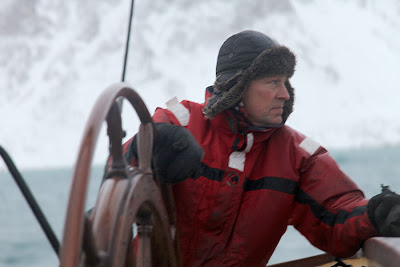
We sailed through the night. At breakfast, Jan told us that we would arrive at Magdalenafjorden by 11am. Shortly after breakfast the ship started rocking and rolling, throwing us about as if we were ping pong balls. I went up on deck to film the rolling seas. I've never seen anything like it. Aaron had to hang on to me while I was filming so I wasn't blown overboard. When I came back in, Willie (one of the artists) was in a complete state of panic, saying "please just make it stop."
It finally did when we arrived at the protected bay of Magdalenafjorden. Audun and I decided to take out the kayak even though there was a frozen rain falling and the swells were still pretty big for kayaking. Audun started out in the single and I shot from the Zodiac thinking that it would be easier to film that way ... it wasn't! I was thrown around in the boat and couldn't hold the camera steady at all. I had rigged the rain cover from my big Sony camera to fit my Cannon SLR. It required using electrical tape to secure the cover around the lens. This seemed like a good idea, but made it impossible to get to the focus ring. Most of what I shot was out of focus and jumpy. The few shots that I did get definitely show what rough water kayaking looks like, although my favorite shots are when I'm flying around yelling "I have no control of the camera!"

 In the afternoon I filmed a project for Kuang-Yu Tsui while a large group took a hike to the glacier. Kuang-Yu stood on an iceberg (a dangerous move that had to be OK'd by both the Captain and Aaron) with a sign as if he were standing at a bus stop. Sebastian was driving the Zodiac. He would pull up to the iceberg, sort of ramming into it, and pick him up as if the Zodiac were the bus and he was the bus driver (even down to accepting the fare). It was difficult to shoot since it was raining and sleeting. I found it impossible to keep the lens clean and was frustrated at not being able to get a good shot. I was also wishing that I could have gone on the walk to the glacier.

Today was a tough day full of frustration. I'm realizing that the trip is coming to an end and I am missing shots that I need for my project. I'm feelings are so conflicted. I miss Bob and my life back in New York so much, but I also realize that this is the most amazing time and landscape that I've ever experienced and I don't want it to end. Matt Holzman described it well when he said he was experiencing "present nostalgia." I'm already missing the moments I'm living.
We raised sail about 3am and started to make our way to Ny Alesund. Shortly after our departure we hit some major weather. The ship was rolling like crazy. Both Katja and I woke up from being thrown about in our bunks and from the noise of things crashing around us. It sounded like every piece of glass on the boat was smashing. Katja and I played a guessing game of name that thing that just flew across our cabin ... tripods, pelican cases, boots, etc.
We have a porthole in the top of our cabin. We could hear all the people who had gone out on deck to get air. People were laughing (somewhat hysterically), screaming, and occasionally crying. Willie was freaking repeating "Oh la la, Oh la la!" Matt and a couple others were trying to make light of the fact that the ship had turned into a rollercoaster. Katja and I could hear Matt laughing (trying to sound reassuringly calm, but actually sounding a bit like a crazy man). A lot of Xanax was used that night -- people were just putting it in each other's mouths. It was definitely a night of Arctic hysteria and would forever after be referred to as the Night of Terror!

 I remember how I felt the first time I saw the schooner Norderlicht. I think pure terror would be a good description. She seemed so small in the big Arctic sea and was bobbing so much I was sure I would be sick as a dog for the next couple of weeks. I couldn't imagine how we would all fit, let alone live and work on her.
  Skype is working well (my ID is Janetbiggs1). Bob and I have been video chatting up a storm. This is a picture of me in my small but warm room.
 Janet Biggs is a New York based video, photo and performance artist. Here you'll find updates on Janet's travels and activities. Visit her website, janetbiggs.com, for more info on Janet's artwork.
 Posts
All Comments
Posts
All Comments


